
January 30, 2026 | By Nick Pfost
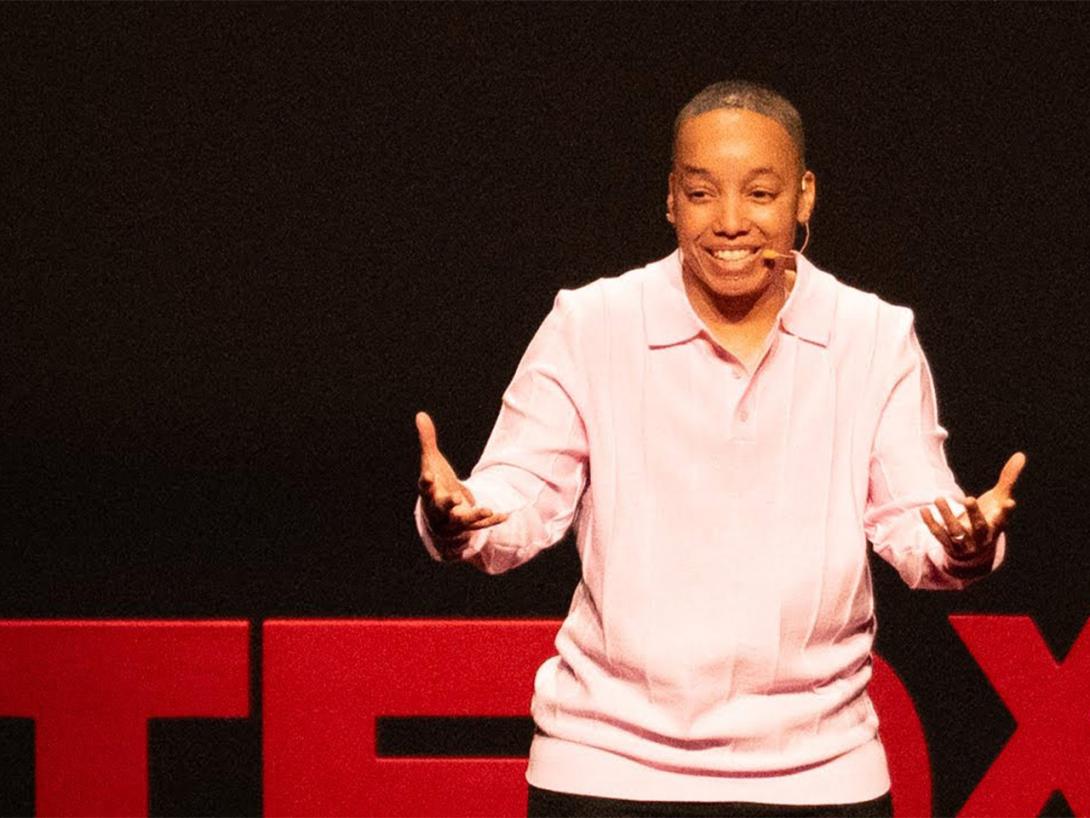
Ever sat in a room when someone says something not-quite-right, and suddenly nobody knows what to do? Angie Freeman, a program manager at Spectrum Center, recently gave a TEDx talk in Oshkosh about those moments and why it matters what happens next.
In their talk, “Countering performative allyship: Courageously calling our own bluff,” they look at ways of moving beyond avoidance to actually stepping up and doing the work. Angie shares personal stories—like being misgendered and realizing their own privilege—to show how we all can be better allies, and how a little courage can turn uncomfortable silences into real change.
Angie has over a decade of experience teaching and speaking about allyship, privilege, LGBTQIA2S+ issues, and their own life. Being Black, trans, nonbinary, queer, a parent, a dancer, and more shapes everything they share. At Spectrum Center, they’re known for their infectious energy and charisma; genuine approach to community, relationships, and collaboration; and dedicated leadership of meaningful events—as well as the daily ‘dad joke.’
Watch the recording and read special behind-the-scenes insights from Angie below.
An inside view from start to stage
In a quick Q&A and Instagram Reel, get an exclusive peek behind the curtain as we ask Angie about their TEDx experience, from manifesting to executing.
Q: How did this opportunity come up, and what inspired you to address the topic of performative allyship at TEDxOshkosh?
Angie: This opportunity came about through connections I made in my speaking community called Speaking 4 Profit. Our guest speaker Cesar Cervantes, who is a TEDx speaker, author, and speaking coach, led a session on how to land a TEDx talk, what to expect during the application process, and how to build out your big idea. I manifested my desire to do a TEDx talk by putting out in the universe that TEDx would be my next big stage. From there, I crafted my big idea, applied to several TEDx applications, got an interview, and ultimately got the opportunity to speak at TEDxOshkosh in Wisconsin.
Performative allyship ignited my interest when I realized I was guilty of passive uninformed allyship. When I posted on my social media about the 2020 Supreme Court ruling on DACA I later realized that I didn't know much about DACA besides the fact that I had loved ones who I cared about that were undocumented and I knew I wanted to support them, but the way I went about supporting was not effective or helpful and arguably instead harmful. From there, I really honed in on the topic and began speaking on it from a personal experience and now an informed one. I chose performative allyship for two reasons (1) because I strongly believe allyship reaches beyond a title or self identification; rather requires intentional action to truly make a difference when supporting marginalized communities. I wanted to challenge those who do call themselves supporters of marginalized communities to overcome valid fears that we all have when it comes to "going against the grain" and settling with the easier action of nonaction. (2) I too benefit from my own message and continue on a journey to show up with intention every single day. I'm not the type of person or speaker to give advice and inspiration to others without me receiving it too. I chose a topic that I once failed and to show authenticity and vulnerability, I too hold myself accountable to my own message and lead with "we're in this together."
What steps did you take to prepare your talk and shape your message for this audience?
I did some one-on-one consulting with two phenomenal humans: (1) Cesar Cervantes and (2) speaking coach and two-time TEDx speaker Michael Ashford. Both of them saw something in me and inspired me to craft my message in a way that was not only true to my character, but also one that would be attractive to the TEDx audience. After my interview with the TEDxOshkosh selection committee, they worked with me to reshape some of my language to be well received not only in our current political climate, but also in the small town of Oshkosh Wisconsin. It was a very collaborative process and the committee allowed me to lead the process and left decisions up to me as the content expert. I attended a speaker skills workshop that focused on content delivery, stage presence, and story-telling. In addition, I practiced A LOT! My wife heard my talk probably a hundred times. My 4 year old loved it when I rehearsed my speech in Donald Duck's voice. I practiced in the car, I wrote it down over and over, I recorded myself - you name it. I even arranged a virtual session for all the speakers to practice their talk and get feedback. The speaker cohort was very supportive and us getting to know each other before the big live event was helpful.
What's something you learned—about yourself or about the topic—through the process of developing and delivering your TEDx talk?
For the first time in my life I trusted myself and drew on the confidence I had suppressed for a long time. I've wanted to do a TEDx talk for awhile now and at the beginning of 2025 I manifested it by posting on social media. I declared that my next big stage - after a historic dance performance in front of 30,000 people at Joe Louis Arena in 2015 - was going to be TEDx. I put it out in the universe, received a lot of encouragement, and boom! I got the call from TEDxOshkosh and they offered me an unforgettable opportunity. I learned that the universe can be powerful in how you approach your desires. I would have never had the courage to manifest something as big as this if it weren't for my speaking community who pushed me to be bold.
Another key thing I learned about myself was to trust my preparation. I had spent all summer and most of fall writing my script, multiple rewrites and edits. Once it was finalized, I gave myself 30 days to go hard in practicing my delivery. My script was my life and I dedicated many hours to my delivery, memorization, body language, voice inflection, tone, pace, enthusiasm, etc. Fast forward when I was backstage in the green room getting ready to go out on stage, I told myself "stop rehearsing, don't overthink it, trust your preparation and go out there and do what you do best" and I DID! I did my thang and I was so very happy with my performance. One piece of advice I held onto throughout my preparation was "instead of wondering 'what if I forget my lines or mix up my stories or completely bomb the entire speech?' Instead, wonder "what if I do great? "What if I'm having the best time of my life out there on stage? What if I get a standing ovation?" Again, it worked! I ingrained all those positive affirmations in myself and I went out there and did what I aspired to do. I trusted myself, I believed in myself. I trusted my preparation and ignited my confidence which left me feeling accomplished. I am humbled by this opportunity and deeply grateful for the innumerable support I've received.
Watch Angie’s TEDx talk on YouTube
We’re proud to have Angie leading the way at U-M, and their message reminds us of the power of everyday courage to make a real difference. Check out Angie’s talk on YouTube.
Read more